Making the Case for Traditional Adult Diapers
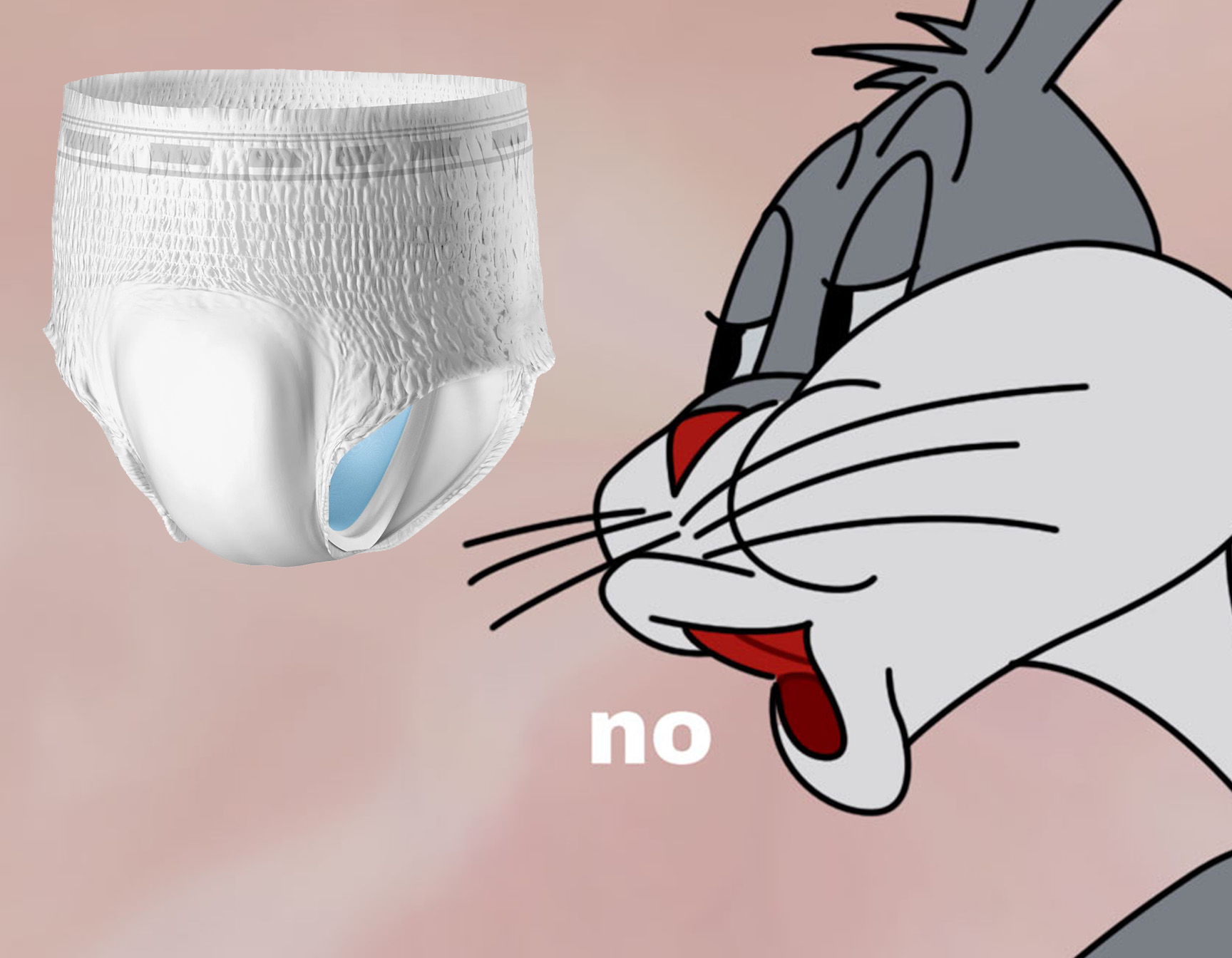
For years, the incontinence aisle has been shaped by one powerful idea: consumers do not want to feel like they are wearing diapers.
That assumption has influenced almost every major store-brand and grocery-store incontinence product on the shelf. The packaging says “underwear.” The colors are gender-coded. The materials are thinner, softer, quieter, and designed to resemble ordinary briefs as much as possible. The word “diaper” is avoided, even when the product is functionally intended to do what a diaper does.
On one level, this makes sense. Incontinence can be emotionally difficult. Many adults are already dealing with embarrassment, anxiety, loss of confidence, or fear of being noticed. If a product looks and feels more like regular underwear, it may feel easier to buy, easier to wear, and easier to accept.
But there is a serious tradeoff that does not get talked about enough:
A product designed primarily to feel less like a diaper may also perform less like one.
And for people who need real protection — especially overnight — that distinction matters.
The Problem With the “Underwear” Promise
After a previous article I wrote about consumer attitudes toward adult diapers and the lack of quality diaper-style products in physical stores, I was contacted by a representative from Kimberly-Clark, the company behind Depend. The point they made was that Depend products can stand shoulder-to-shoulder with traditional adult diapers, and that consumers overwhelmingly prefer their more discreet “fresh protection” style products over bulkier tab-style briefs.
So I decided to test that claim for myself.
I went to a local grocery store and purchased Depend Night Defense Underwear for Men, one of the company’s more absorbent pull-up style products. On the package and website, Depend makes some strong promises: up to 12 hours of protection, odor control, a DryShield core, soft cotton-like materials, and super absorbent polymers capable of absorbing many times their own weight.
That all sounds impressive.
But absorbency claims can be misleading when they are separated from real-world use. A product may technically absorb a certain amount under controlled conditions, but that does not mean it can reliably handle a full bladder release while the wearer is lying down, shifting in bed, or sleeping on their side.
And that is where the difference between pull-up underwear and traditional adult diapers becomes impossible to ignore.
Thinness Comes at a Cost
The first thing I noticed before even putting on the Depend Night Defense was how thin it was.
That is not automatically a bad thing. For many people with light or moderate leakage, a thinner product can be comfortable and convenient. Pull-ups are easy to wear during the day, especially for people who are mobile, independent, and able to reach the bathroom most of the time.
But overnight incontinence is different.
At night, the product has to work while the wearer is asleep. It has to handle larger voids, slower reaction times, body movement, pressure from lying down, and the reality that urine does not always land neatly in the center of the absorbent core. For side-sleepers, this is especially important. If the absorbent material is concentrated in a narrow strip down the middle, there is very little margin for error.
Traditional adult diapers — especially higher-quality tab-style briefs — are usually designed with more coverage, more padding, taller leak guards, better containment zones, and a more secure fit around the legs and waist. They may look bulkier, but that bulk is not meaningless. It is part of the protection.
In other words, the very thing many companies try to reduce is often the thing that makes the product work.
My Overnight Test
To make the test fair, I tried to approach the product the way an average consumer might.
I did not add a booster pad. I did not use an underpad. I did not layer another product over it. I simply wore the Depend Night Defense as it is marketed: as an all-in-one overnight solution.
That distinction matters. The packaging does not tell the consumer, “This may only work if paired with additional protection.” It presents the product as nighttime defense.
I also took reasonable precautions. I limited fluids before bed and used the bathroom beforehand. It was a normal overnight scenario.
Unfortunately, the product did not hold up.
At some point during the night, I had a significant bladder release. To Depend’s credit, it did absorb some of the urine at first. For a few seconds, it seemed like the core was doing its job.
But then the liquid began moving toward the sides and back. Once I shifted onto my side, the product leaked.
By morning, the underwear was heavy, sagging, and clearly overwhelmed. When I stood up to change, the absorbent core failed further, releasing liquid in a way that turned a leak into something much worse.
This was not simply a matter of “any product can leak.” Of course any product can fail under the wrong conditions. The issue is that this product was marketed as overnight protection while lacking the structural safeguards that a true overnight diaper-style brief would usually provide.
Pull-Ups Have Their Place — But They Are Not the Gold Standard
It would be unfair to say pull-up style products are useless. They are not.
For many people, they are an excellent option for:
- Light urinary leakage
- Occasional urgency
- Daytime use
- People who can still toilet independently
- Situations where discretion matters more than maximum capacity
- Consumers who are emotionally easing into protection
Pull-ups can be empowering when they match the wearer’s needs.
The problem is when they are treated as the default solution for everyone.
A person with heavier incontinence, overnight wetting, mobility challenges, bowel incontinence, side-sleeping leaks, or full bladder voids may need something more substantial. In those cases, a traditional adult diaper is not a step backward. It is often the more practical, more comfortable, and more dignified choice.
Real dignity is not pretending a product is underwear.
Real dignity is waking up dry.
Real dignity is not having to strip the bed at 3 a.m.
Real dignity is not worrying whether one accident will become a disaster.
Real dignity is having protection that actually matches the body’s needs.
The Shame Around the Word “Diaper”
One of the biggest barriers to better products is language.
Companies avoid the word “diaper” because consumers avoid the word “diaper.” Consumers avoid the word because they have been taught to associate it with helplessness, embarrassment, or childishness. The result is an entire marketplace built around euphemisms: underwear, briefs, guards, shields, protection, absorbent products.
But avoiding the word does not change the function.
If a product is designed to absorb and contain urine or stool when the wearer cannot reliably make it to the toilet, then it is serving the role of a diaper. That does not make it shameful. It makes it useful.
As members of the AB/DL community, we occupy an unusual position in this conversation. We are already comfortable with diapers in a way many people are not. For us, the word does not carry the same automatic sense of humiliation. That gives us a perspective that can be valuable — not because everyone should relate to diapers the way we do, but because we understand something many mainstream consumers are still struggling with:
A diaper is not inherently degrading.
A diaper can be secure. Comforting. Practical. Well-designed. Reliable. Even confidence-building.
For people with incontinence, that mindset shift can be life-changing.
Traditional Adult Diapers Offer Practical Advantages
A good tab-style adult diaper is not merely a bulkier pull-up. It is a different category of protection.
Traditional adult diapers often provide:
- Greater absorbent capacity
- Better front-to-back coverage
- More effective leak guards
- A more adjustable fit
- Better performance while lying down
- Easier changing for people with mobility issues
- More room for booster pads if needed
- Better containment for heavy voids or multiple wettings
The tapes or tabs are not a drawback; they are part of the design. They allow the wearer or caregiver to customize the fit around the legs and waist. They also make changes easier without removing pants and shoes, which can be a major benefit for people with limited mobility.
The extra padding is not a flaw; it is protection. The higher rise is not embarrassing; it is coverage. The crinkle, thickness, and structure that some consumers fear may actually be the features that prevent leaks.
Store Shelves Need Better Options
Another major issue is availability.
High-quality adult diapers are often easiest to find online. Brands that specialize in premium tab-style briefs tend to offer much better performance than the average grocery-store product, but many consumers never encounter them. If someone only shops at a local pharmacy, supermarket, or big-box store, they may assume that Depend, Always Discreet, or similar pull-up products represent the best available protection.
They do not.
They represent what major retailers believe consumers are most willing to buy publicly.
That is an important distinction.
The average consumer may not know that more absorbent, better-designed options exist. They may simply keep buying inadequate products, adding underpads, changing sheets, layering protection, or blaming themselves when leaks happen.
But the failure is not always the wearer’s fault.
Sometimes the product is simply not built for the job.
The Conversation We Should Be Having
The incontinence industry needs to stop treating discretion as the highest virtue.
Discretion matters, yes. But it should not come at the expense of function. A thin product that leaks discreetly is still a product that leaks. A more underwear-like design is not helpful if the wearer wakes up wet, anxious, or ashamed.
Instead of asking, “How can we make this look less like a diaper?” companies should be asking:
- Does this product protect people during real overnight use?
- Does it work for side-sleepers?
- Can it handle full bladder voids?
- Does it offer enough coverage beyond the center core?
- Are consumers being clearly informed about its limits?
- Are better options available in stores for people who need them?
That would be a more honest, more compassionate approach.
Choosing Protection Without Shame
If you are someone managing incontinence, the best product is not the one that looks most like underwear. The best product is the one that lets you live with the most comfort, confidence, and peace of mind.
For some people, that will be a pull-up.
For others, especially at night, it may be a traditional adult diaper.
And that is okay.
There is no shame in needing more protection. There is no shame in choosing a thicker product. There is no shame in wearing something that is visibly, honestly, and functionally a diaper if that diaper gives you a better night’s sleep and a drier morning.
As AB/DL creators, advocates, and consumers, we can help normalize that conversation. We can speak plainly. We can challenge the idea that “diaper” is a dirty word. We can encourage people to evaluate products based on performance rather than packaging.
Because at the end of the day, incontinence products should not be designed around denial.
They should be designed around real bodies, real needs, and real protection.
And sometimes, the most mature choice an adult can make is choosing the diaper that actually works.