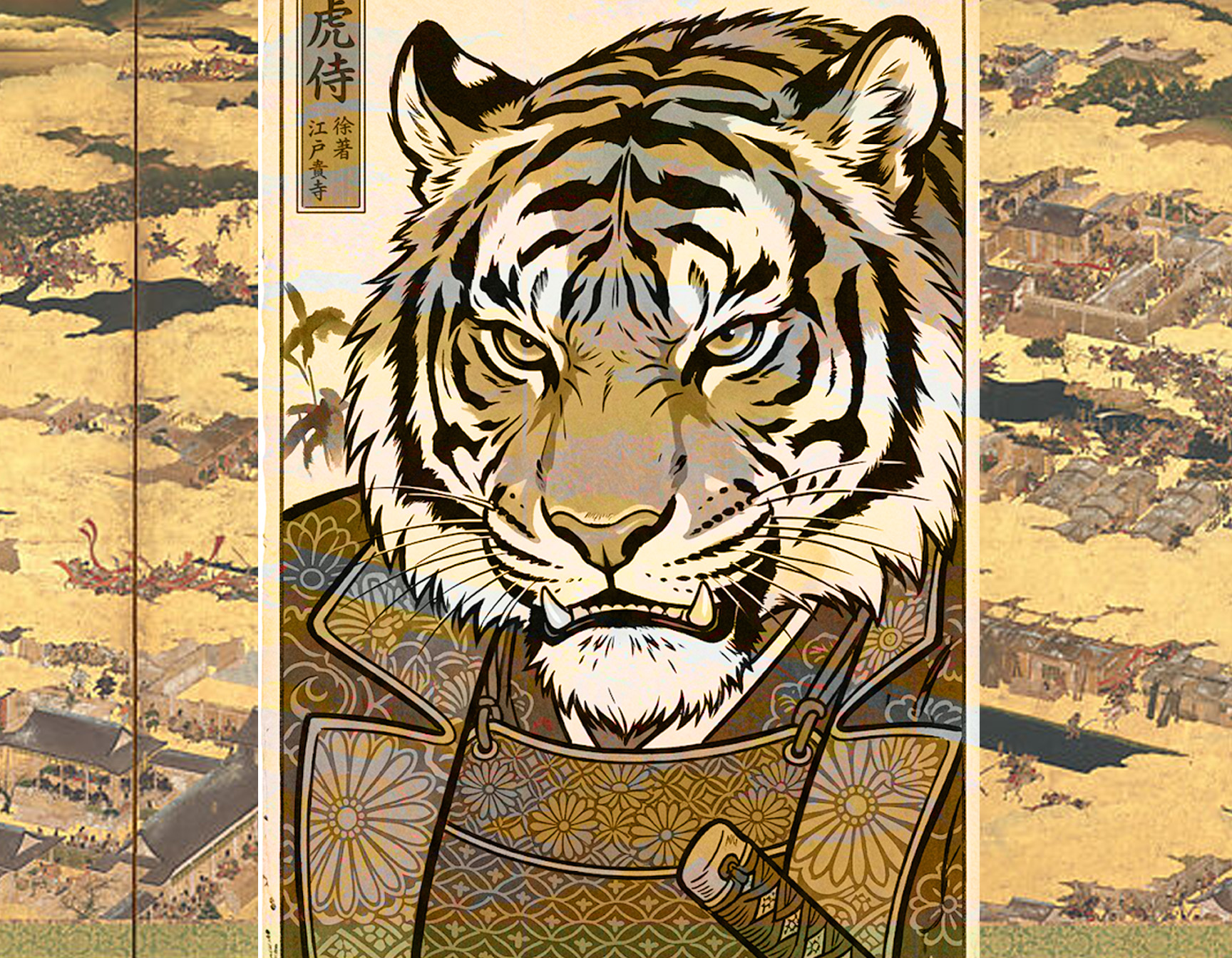
The paddies caught the light before the village did. Mist still sat in the low places between the rows, and the stalks stood knee-high and heavy with water, bending slightly in a wind that hadn’t decided yet what direction it wanted. A heron worked the far edge of the nearest field, stabbing at the shallows with the patience of something that had never once been in a hurry.
The first villagers were already out. A cheetah in a faded indigo loincloth moved along the berm between two paddies, his feet finding the narrow path without him looking down. Two otters walked the main road with baskets balanced on their backs, talking in the low, clipped way of people who’d had the same conversation a hundred times and no longer needed all the words. A young avian chased a dog between the buildings and the dog won.
It was the kind of morning that didn’t ask anything of anyone.
Then the stranger came up the south road.
He moved at the pace of someone who had been walking since before the light changed — not slow, not hurried, just continuous, like something that didn’t stop. The hood was deep enough that the face beneath it stayed shadow. What wasn’t hidden was the size of him: the width across the shoulders, the way the road seemed slightly too narrow for the space he occupied. The two scabbards crossed on his back shifted with each step, the longer one riding high, the shorter one angled beneath it.
The otters with the baskets stopped talking.
The cheetah on the berm didn’t look up, but his feet slowed.
The stranger moved to the far edge of the thoroughfare, giving the nearest cluster of villagers the full width of the road. He kept his chin down. The wind was at his back and he’d chosen that deliberately — had been choosing it since he’d first smelled the cookfires and the animal pens and the particular human density of a village at morning. Downwind. Always downwind.
A child pointed. Her mother caught the hand and pulled it down without a word.
He didn’t stop walking.
The gap between the two buildings came up on his left — dark, narrow, smelling of old wood and river mud. He turned sideways to fit his shoulders through, one hand pressed flat against the planks to feel for rot, for give, for anything that might creak and announce him. The village noise stayed on the other side — the wet slap of sandals on packed earth, the creak of a cart wheel, a woman calling something short and sharp to someone who didn’t answer. He listened to all of it and kept his breathing shallow.
His bladder had been a problem since before dawn.
He’d held it through the last two ri of road, through the checkpoint at the village edge where a farmer had stopped and stared too long at the swords on his back, through the whole careful business of threading himself through the morning crowd without brushing against anyone. The hood helped. People looked at the hood and then looked away, which was the point.
Now he planted his feet in the dirt, close to the wall, and let go.
The sound was immediate and humiliating — loud against the wood, louder than he’d expected — and he pressed his forehead to the planks and waited for it to stop. It didn’t stop for a long time. The stream cut a dark channel through the dust and crept toward the alley’s mouth, thin and unhurried, finding the slope of the ground the way water always does.
He watched it reach the edge of the shadow and keep going.
Move.
He shook his left leg once, twice, felt the wet cling of his hakama against his ankle, and stepped back. The puddle had already spread into the thoroughfare, catching the morning light. A lioness in indigo cotton walked past the alley’s mouth without looking down. Then a ferret, barefoot, who stopped, looked at the spreading dark stain on the ground, looked up at nothing in particular, and walked on.
He waited until the ferret was gone.
The katana’s grip caught the edge of the building as he turned — a soft knock of lacquered wood against timber — and he went still again, one hand coming up to steady the scabbard. Nothing. The cart wheel creaked somewhere further down the road. The smell of the rice paddies came in on the wind, green and faintly rotten, the way standing water always smells when the sun first hits it.
He pulled the hood lower and stepped back out into the thoroughfare, moving with the current of the crowd, not against it. His ankle was still damp. He didn’t look back at the alley.
The village had a well at its center, and beyond the well, a road heading north. He fixed his eyes on the road and kept walking, shoulders angled inward, the twin hilts riding low and quiet against his back.
Nobody stopped him. He hadn’t expected them to.
The inn announced itself before he reached it — a smell of charcoal and miso and something frying in oil that cut through the road dust and the paddies and the lingering sourness of his own clothes. A wooden sign hung above the entrance, the characters painted in faded red. The noren curtain across the doorway was the color of old mustard, split down the middle, the fabric worn thin at the edges from ten thousand hands pushing through it.
He pushed through it.
The interior was low-ceilinged and warm, the air thick with smoke from the cooking fire and the particular closeness of a building that held too many people in too small a space. Tatami mats covered the floor in the common area. Three men sat around a low table near the far wall, eating without talking, their bowls close to their faces. A woman moved through a doorway at the back carrying a tray, glanced at him once, and kept moving.
The innkeeper materialized from behind a wooden partition before the noren had finished swaying.
He was a hyena — shorter than expected, built narrow through the shoulders but wide at the hips, moving with the particular ease of someone who had spent decades navigating tight spaces between furniture and guests. He wore a pink kimono, the color of cherry blossoms past their peak, belted loosely at the waist, and a pair of small round eyeglasses that sat low on his muzzle. The lenses caught the firelight. His spotted coat was going grey at the muzzle and along the backs of his hands, but his eyes were quick and missed nothing — they went to the swords first, then the hood, then the damp hem of the hakama, and then back up to where a face would be, all in the time it took him to cross the room.
“Welcome,” he said, and his voice had the practiced warmth of a man who had said the word ten thousand times and still meant it approximately half of those. “Weary traveler. Come in, come in.” He gestured broadly at the interior as though he were presenting something grander than it was. “Are you looking for a room this evening?”
“Yes.” The tiger’s voice came out lower than he’d intended, roughened by road dust and hours of silence. “One room. One night.”
“Excellent.” The hyena clasped his hands together. “Basic fare runs one hundred mon. That covers the room and two meals — morning rice, evening broth, whatever the kitchen has managed today.” He paused, tilting his head slightly, the glasses catching the light again. “But.” He raised one finger, the gesture unhurried, almost theatrical. “We do have a fine selection of yūjo available this evening, should the traveler find the night long.” The corners of his mouth pulled back — not quite a grin, something more measured than that. “And I suspect one or two of them might find your particular… scent agreeable.”
The tiger said nothing for a moment.
“I’ll decline,” he said. “The room.”
“Of course, of course.” The hyena lowered his hand without any visible disappointment. He had the manner of a man who heard no regularly and had long since stopped taking it personally. He turned slightly, gesturing toward the back corridor. “We also offer bathing facilities. Squat toilet as well, freshly maintained.” He let his eyes drop — briefly, professionally — to the hem of the hakama, to the dark stain dried into the fabric above the ankle. When he looked back up, there was something in the set of his mouth that was not quite a smile and not quite not one. “Though it appears you may have already attended to certain necessities.”
The tiger’s jaw tightened under the hood.
“A wise warrior,” he said, “does not enter a bath. He will not be caught without his swords.”
The hyena was quiet for a moment. He reached up and adjusted his glasses with one finger, pushing them back up the bridge of his muzzle. Then he nodded — a single, slow dip of the head, the levity gone from his face, replaced by something that looked, if not like respect, then at least like recognition.
“Ah,” he said. “Yes. I understand.”
He turned toward the partition and lifted a small wooden key from a hook on the wall. “Room four,” he said. “End of the corridor, faces the garden. Quieter than the road side.” He held the key out without ceremony. “Evening meal is at the second bell.”
The tiger took the key. His fingers were careful not to touch the hyena’s hand.
“One more thing.” The hyena had already begun to turn away, but he paused, half-facing the room. “The other guests.” He said it without looking back. “They will not trouble you, if you do not trouble them. This is a house of commerce, not of judgment.” He adjusted his glasses again. “We are all of us, at one time or another, in need of a room.”
He disappeared behind the partition.
The three men at the low table were still eating. None of them had looked up.
The tiger stood in the middle of the room for a moment, the key warm in his palm, the fire crackling in the kitchen beyond the wall, the smell of miso thickening the air around him. Then he turned and walked toward the corridor, his footsteps quiet on the tatami, the twin hilts of his swords clearing the doorframe by less than a finger’s width.
Room four was at the end of the corridor, separated from the last guest room by a thin partition of cedar planking and paper. He could hear the man next door before he reached his own door — the shift of weight on tatami, the soft knock of a ceramic cup set down too carefully, the particular stillness of someone trying not to make sound.
He noted it and slid his own door open.
The room was small and without pretension: a sleeping mat rolled against the far wall, a low table with an unlit oil lamp, a single zabuton cushion centered on the tatami, a window facing the garden that let in the last of the afternoon light through paper screens gone amber with age. A ceramic water basin sat in the corner. The garden beyond the screen was mostly shadow and the sound of wind moving through something leafy and close.
He stepped out of his sandals at the threshold and left them there.
The hood came off slowly — he worked it back with both hands, the fabric catching briefly on his ears before releasing. The room held the warmth of the day and the smell of old tatami and cedar, and after hours of road dust and open sky it pressed against him like something solid. He set the hood on the low table. Beneath it he wore an orange hakama, the fabric road-worn but intact, layered over a white hakama-shita that had gone grey at the collar from sweat and travel. He rolled his shoulders once, feeling the swords shift on his back, and then crossed to the zabuton and lowered himself onto it.
The tatami gave slightly under his weight.
He sat with his legs folded, his hands open on his knees, the swords still on his back — always on his back, always within reach. He let his eyes close.
This was not sleep. Sleep was a different kind of surrender. This was the opposite: a narrowing, a focusing inward until the body became a instrument of pure reception. The sounds of the inn organized themselves around him — the three men in the common room, one of them coughing now, the woman with the tray moving through the kitchen, the innkeeper’s voice somewhere distant and indistinct. The garden. The wind. The man next door, who had gone very still.
Too still.
There is a quality to stillness that is chosen, and a quality to stillness that is predatory, and they do not feel the same. The man next door had stopped trying not to make sound. He had stopped making sound entirely, which was different, and worse.
The tiger’s hands stayed open on his knees.
He felt it before he heard it — a minute displacement of air, the faint vibration of a blade finding purchase in wood — and he was already moving when the katana punched through the left wall, the tip stopping six inches from where his shoulder had been a half-second prior. He’d leaned back from the hips, spine nearly parallel to the floor, and held there while the blade scraped against the cedar trying to find him.
A diversion.
He knew it was a diversion because the door was already opening.
He came upright and drew in the same motion — the katana clearing its scabbard with a sound like an intake of breath — and turned to face the figure entering from the corridor. Dark from crown to sole: shinobi shozoku wrapped tight at the wrists and ankles, a hood leaving only a strip of eyes visible, a tantō held low and forward in a grip that knew what it was doing.
The figure crossed the room fast.
The tiger caught the knife hand at the wrist.
Not deflected. Not redirected. Caught — fingers closing around the wrist like a trap springing, the tantō stopping dead in the air between them, the assassin’s forward momentum absorbed and held. The figure’s eyes changed above the hood. The tiger watched them change. He’d seen it before: the moment when a trained body encounters something it has no category for and the mind goes briefly white.
He opened his own eyes fully then, and the assassin stepped back.
The tiger swung.
He was still seated on his heels, weight low, and he swung from that position — a single lateral arc, controlled, the blade moving faster than the eye could parse it into stages. The assassin’s trained gaze tried to track it and failed. The sword stopped a finger’s width from the figure’s throat, held there, perfectly still.
The room was quiet.
The assassin looked at the blade. Then at the eyes above it. Then, with the deliberate economy of someone making a decision they would not revisit, stepped backward through the doorway, caught the frame, pivoted, and was gone — no sound in the corridor, no sound on the stairs, nothing. The noren at the inn’s entrance didn’t even stir.
The tiger held the sword out for another breath, then brought it back and sheathed it.
He stood.
The orange hakama fell to the tatami in a single motion, untied and dropped, and what it revealed stopped him for a moment — not from surprise, but from the particular quality of attention he gave to everything. The fundoshi had been white that morning. It wasn’t white now. The fabric hung heavy against him, soaked through, warm still, the weight of it pulling the linen taut. It had happened during the exchange — not before, not after, but during, somewhere in the half-second between catching the knife and opening his eyes. His body’s oldest reflex, the one that predated training by a thousand years: the bladder releasing under the full voltage of combat readiness.
He’d long since stopped fighting it.
He pressed one hand flat against the front of the fundoshi and felt the heat still radiating through the linen, the liquid shifting under the pressure of his palm, the fabric giving slightly. A thin stream continued down the inside of his thigh and dripped from his knee onto the tatami, darkening the woven grass in a slow, spreading circle.
He looked down at it.
The smirk came without effort — small, private, belonging to no one else in the room. He’d bled for lesser victories than this. The assassin had come prepared, had come with a diversion and a blade and the discipline of years, and had left with nothing but the memory of a sword he couldn’t follow with his eyes.
He didn’t know the assassin’s name. He rarely did.
What he knew was the weight of accumulated enemies — the ones he’d left breathing and the ones he hadn’t, the feudal lords whose retainers he’d refused, the men whose brothers he’d put in the ground on someone else’s contract, the factions that kept lists. The lists were long by now. He’d stopped being surprised by the attempts and started cataloguing them instead, the way a craftsman catalogs the tools that have failed him.
The corridor was empty. The common room was empty. He pushed through the noren and back into the afternoon.
The village had not noticed anything. He moved through it methodically, quartering the streets the way he’d been taught to quarter a battlefield: near to far, shadow to light, high ground first. He checked the rooflines. He checked the spaces between buildings — including the alley he’d used himself, which now smelled only of old wood and what he’d left there. He stopped two farmers and a woman carrying firewood and asked his questions plainly, without preamble, and received the same answer from all three: blank faces, small shakes of the head, the particular blankness of people who had genuinely seen nothing.
He went back to the inn.
The innkeeper was behind his partition, moving papers around with the focused air of a man who had decided to be very busy. He looked up when the tiger appeared in the doorway, and his expression was open and mild and revealed absolutely nothing.
“Any trouble?” the hyena asked.
“No,” the tiger said, which was true in the way that mattered.
He stood in the doorway for a moment longer than necessary, reading the man’s face, and then turned and walked back out into the street.
The izakaya sat two streets over from the well, identifiable by the cedar barrel hung above the entrance and the sound of voices that spilled under the door even in the middle of the afternoon. He pushed inside and stopped to let his eyes adjust.
The room swallowed the daylight completely. No windows — just the low orange glow of paper lanterns strung along the ceiling beams and the warmer, dirtier light of candles on the counter. The smell hit him immediately: fermented rice and charcoal smoke and the close animal warmth of two dozen bodies in an unventilated space. It was the smell of loosened tongues and lowered guards, which was exactly what he’d come for.
He took the last open seat at the counter, between a boar whose tusks had been filed to blunt points and a dragon who sat with his tail coiled under the stool and his cup held in both hands like something precious. A server appeared without being summoned and set a ceramic flask in front of him — complimentary, apparently, the house’s way of priming the pump. He poured his own cup and drank half of it slowly, letting the warmth settle in his chest, and listened.
The boar noticed the soaked hakama first. The tiger felt the look before he saw it — a sidelong thing, dropping to the indigo fabric, then back up with the particular expression of a man who has decided he has found something to say.
“Made quite a foul mess of yourself, swordsman.”
The tiger set his cup down. “And what of it.”
It wasn’t a question. The boar heard that and pushed forward anyway, the way boars do.
“Can’t walk into a place looking like that. Have some civility.”
The tiger turned his head and looked at the boar directly for the first time. He let the silence sit for a moment — not long, just long enough to be felt.
“You seem flustered,” he said. He picked up his cup again. “I could be less civilized, if that’s what you’d prefer.”
The boar’s ears went back. A flush moved up through the grey bristle of his jaw and he reached up and rubbed one tusk with the back of his hand, a gesture that had no purpose except to give his hands something to do. “I don’t know about all that, but —”
A hand came down on the tiger’s shoulder.
Not a grab. A placement — deliberate, unhurried, the palm settling against the muscle at the base of his neck with a familiarity that had not been earned and somehow didn’t feel presumptuous. The tiger went very still in the way that a blade goes still when it’s been drawn and not yet committed to a direction.
“Fancy seeing you here,” the hyena said, “at this hour.”
He came around to the tiger’s left and leaned one elbow on the counter, positioning himself between the tiger and the boar with the smooth unconscious ease of a man who has spent his life managing the geometry of rooms. The pink kimono had been exchanged for a deeper rose, the sash tied more loosely than before. The eyeglasses sat low on his muzzle. He smelled of cedar and something faintly sweet — plum wine, maybe, or just the residue of a building that had been soaking in fermented things for decades.
“Nothing wrong,” the tiger said, “with a drink.”
“Nothing at all.” The hyena signaled the server with two fingers and a second flask appeared. He poured for himself without pouring for the tiger, which was either an oversight or a statement. “Any luck with your intruder?”
“Not yet.”
“Mm.” The hyena sipped. His eyes moved across the room over the rim of his cup — not searching, just reading, the habitual surveillance of a man whose livelihood depended on knowing what was happening in every corner of every space he occupied. “He’ll come back, you think?”
“When he does,” the tiger said, “I’ll be ready.” He reached back and tapped the hilt of the katana with two fingers, a small gesture, almost casual.
The hyena looked at the hand on the hilt. Then at the hakama. Then back up, and there was something in the set of his mouth — not mockery, not quite, but something adjacent to it that had warmth underneath.
“Such appetite for it,” he said. “The battle.” He tilted his head slightly. “And yet. A warrior of your obvious capability —” He let his eyes drop again to the indigo fabric, to the faint darker patch still visible at the hem. “— with a bladder that surrenders before the fight is finished.” He clicked his tongue softly. “One would think that a significant distraction.”
The tiger turned to look at him fully.
The hyena did not look away. Behind the lenses, his eyes were steady and bright and entirely too interested.
“It’s strategy,” the tiger said.
One spotted eyebrow rose above the frame of the glasses. “Strategy.”
“I don’t enter a bath. I don’t remove my swords. My defense has no gaps.” He held the hyena’s gaze. “What you call a weakness is the cost of an absolute guard.”
The hyena was quiet for a moment. He turned his cup slowly in his fingers, the ceramic making a soft sound against the counter. The lantern light caught the lenses of his glasses and turned them briefly opaque, hiding his eyes, and then he tilted his head and they cleared again.
“A reasonable argument,” he said. His voice had dropped slightly — not to a whisper, but to the register of a conversation that had decided it was private. “For a man who had no other choice.” He paused. “But I’ve been watching you since you walked through my door this morning.” Another pause, longer. “And I don’t think that’s the whole of it.”
The tiger said nothing.
“You could have used the toilet before you left the room,” the hyena continued, almost gently. “You had time. The assassin was gone.” He set his cup down and folded both hands around it. “And yet.”
The tiger picked up his own cup. Drank. Set it down.
“You’d lose that wager,” he said.
“Would I.” The hyena smiled — slow, private, the smile of a man who has already decided he’s won something and is in no hurry to collect. He reached up and pushed his glasses back into place with one finger, the gesture precise and unhurried. “I’ve run an inn for twenty-three years, swordsman. I have seen every variety of man come through that door.” His elbow was still on the counter, his body angled toward the tiger, close enough that the tiger could feel the warmth radiating off him through the thin silk of the kimono. “I know the difference between a man who endures something and a man who —” He paused, choosing the word with visible care. “— cultivates it.”
The boar on the tiger’s right had gone very quiet. The dragon was staring into his cup.
The tiger looked at the hyena for a long moment. The lantern light moved between them, the flame in the nearest paper globe bending slightly in a draft from somewhere, throwing their shadows sideways across the counter and back.
“You’re a bold innkeeper,” the tiger said finally.
“I’m a curious one,” the hyena said. He picked up his cup again. “There’s a difference.” He drank, watching the tiger over the rim. “Though I suspect you already know that. You strike me as a man who finds boldness —” The cup came down. “— interesting.”
The tiger said nothing.
But he didn’t look away either.
“And if you truly value boldness —” The hyena leaned in slightly, just a degree, just enough that the tiger could feel the warmth of him across the narrow space between their shoulders. His voice dropped, not to a whisper but to something that belonged only to the two of them despite the room full of bodies. “— would you dare stain yourself further?” The lenses of his glasses caught the lantern light and held it. “Here. Now. In front of all of them — if the urge happened to arise.”
The tiger looked at him.
“Sounds like you want me to defile myself.”
“Sounds like —” The hyena set his cup down with a soft, final click. “— you’re stalling because you’re embarrassed.” He tilted his head, the smile not quite arriving but living just beneath the surface of his expression. “Is this the ceiling of your samurai pride? A dare from an innkeeper?”
The tiger said nothing for a moment.
He turned it over. Not the dare itself — the dare was simple, almost insultingly so — but the architecture of the moment. He had no lord. No clan mon on his back, no master whose reputation he carried, no retainer watching from the corner to report back. The code he followed was the one he’d written himself, revised in blood across a decade of roads that led nowhere permanent. He’d done this in rice paddies at dawn, in the middle of crowded market streets, in the final seconds of fights that hadn’t finished yet. He’d done it and sheathed his sword and kept walking.
The hyena hadn’t dared him to do something shameful.
He’d dared him to do something the tiger had already done a hundred times, in front of strangers who hadn’t earned the right to watch.
This one, at least, had asked.
The tiger set his own cup down. He turned back to the counter and took hold of the edge of it with both hands — not for balance, but for the particular satisfaction of having something solid to grip. The wood was worn smooth by years of elbows and spilled sake. He spread his feet slightly on the floor, felt the tatami compress under his weight, and bent his knees a fraction.
He bore down.
His stomach had been heavy since morning — the kind of accumulated weight that travel and tension and skipped meals produces, impacted and insistent. He’d been aware of it the way he was aware of most discomforts: noted, filed, deferred. Now he stopped deferring.
It took less than half a minute.
The sound arrived before anything else — a low, resonant report that cut through the ambient noise of the izakaya like a blade through silk, followed immediately by the dense, unmistakable weight of it settling into the back of his hakama. The fabric strained and held. The smell followed, thick and immediate, spreading outward in a radius that the lantern light did nothing to soften.
The izakaya went silent.
Not gradually — all at once, the way a room goes silent when something happens that no one has a prepared response for. Cups stopped moving. Conversations stopped mid-syllable. The boar on his right made a sound low in his throat and pushed his stool back two feet. The dragon on his left stood up entirely, tucking his tail, and relocated to the far end of the counter without looking back. Around the room, bodies shifted away from him in a slow, involuntary tide — some with visible disgust, mouths pulled tight, eyes averted. Others with something less clean than disgust, something that looked at the tiger and then looked away too quickly, the way people look away from things they want to keep looking at.
The tiger released the counter. He straightened. He was breathing harder than he’d expected — not from exertion but from the particular physiological aftermath of it, the body’s sudden lightness after prolonged weight, the strange clarity that followed.
The hyena had not moved.
He stood exactly where he’d been, elbow on the counter, cup in hand, close enough that the tiger could feel the warmth of him still radiating through the silk of the kimono. He looked at the tiger with an expression that had finally resolved itself into something legible: not shock, not disgust, not the performative horror of the room around them. Something more considered than any of those. Something that had been waiting to see what the tiger would actually do and had now received its answer.
“How foul,” the hyena said. His voice was even. Almost gentle. “Crude.” A pause. “But bold. Unquestionably bold.”
The tiger looked at him.
His chest was still moving faster than normal. The hakama hung heavy behind him, the warmth of it pressing against the backs of his thighs. The room had reorganized itself around a new center of gravity — him, and the empty space the other patrons had left around him, and the hyena who had declined to join them in leaving.
“You didn’t move,” the tiger said.
“No,” the hyena agreed. He pushed his glasses up with one finger. “I didn’t.” He looked the tiger over — unhurried, thorough, the same inventory he’d taken in the inn doorway that morning, but slower now, and with different information available to him. “You know,” he said, “most men, when they’ve made their point, look satisfied.” He tilted his head. “You look like you’re waiting for something.”
The tiger said nothing.
“Perhaps,” the hyena continued, and now the smile did arrive, small and private and directed at no one in the room except the tiger, “you really do need to be swaddled.”
The tiger blinked. Once.
“Swaddled.”
“Mm.” The hyena straightened from the counter, smoothing the front of his kimono with both hands, unhurried. He was shorter than the tiger by nearly a head, but he occupied the space between them without any apparent awareness of the difference. He glanced once around the room — at the evacuated stools, the averted eyes, the server who had retreated to the far end of the counter and was studying the wall with great intensity — and then back at the tiger.
“Come with me,” he said. “Samurai.”
He turned and walked toward the door without checking to see if the tiger followed.
The tiger stood for a moment in the wreckage of the room’s silence, the weight of the hakama against him, the smell of what he’d done hanging in the still air of the windowless space. The boar was staring at the counter. The dragon had his back turned entirely.
He picked up his sake cup. Drank the last of it. Set it down.
Then he followed the hyena out into the afternoon light.
The hyena’s quarters sat behind the inn proper, connected by a narrow covered walkway that smelled of cedar and rain-dampened earth. The tiger had to duck slightly to clear the entrance. Inside, the transition was immediate and total — from the inn’s commercial warmth to something quieter, more deliberate. A private world.
The cha-no-ma was small and unhurried. Tatami, a low table of dark-grained wood, a single scroll hanging in the tokonoma alcove — brushwork, a mountain rendered in three strokes. The incense was already burning, had been burning for some time, the smoke thin and pale and carrying something resinous underneath the sweetness, like cedar left in the sun. The tiger stood in the entrance and breathed it in without meaning to, felt something in his chest that had been wound tight since before dawn begin, incrementally, to release.
The irori sat in the corner, a square hearth sunk into the floor, coals banked low and patient beneath an iron kettle that was already murmuring. The hyena moved to it without ceremony, crouching beside it with the ease of long habit, and ladled green tea into a ceramic bowl — rough-glazed, the color of river clay, the kind of vessel that had been used so many times it had absorbed something of every hand that held it.
He brought it to the tiger and held it out.
The tiger took it. Sat. The bowl was warm against both palms and the tea was grassy and slightly bitter and exactly what his body wanted without having known it wanted anything. He drank slowly. The hyena watched him drink with the patient attention of a man who has offered hospitality and is waiting to see what it reveals.
Then he stood, smoothed the front of his kimono, and disappeared through the interior doorway.
The tiger listened to the sounds of the other room — a chest opening, fabric moving, the soft percussion of the hyena’s unhurried search. He looked at the scroll in the alcove. The mountain. Three strokes.
The hyena returned.
What he carried was folded thick, cotton the color of unbleached linen, substantial in a way that registered even across the room. He held it in both hands, not presenting it exactly, but not concealing it either. He set it on the low table between them and stepped back.
The tiger looked at it.
His mind assembled what his eyes were telling him and then stalled on the assembly, the way a blade stalls on bone.
“This is —”
“Your destiny.” The hyena’s voice had changed registers entirely — the warmth of the innkeeper, the dry wit of the izakaya, both gone, replaced by something flat and certain and without any softness in it at all. He looked at the tiger over the rims of his glasses with eyes that had stopped performing anything. “Your diaper.”
The word landed in the room and stayed there.
The tiger had faced men who wanted to kill him and felt less exposed than he did in this moment, sitting cross-legged on another man’s tatami with a bowl of tea going cool between his palms. He understood violence. He understood the grammar of it, the way it announced itself, the way his body knew what to do before his mind caught up. This was a different grammar entirely. This was something that reached past the swords and the training and the accumulated scar tissue and found something older underneath — something that had no name in the vocabulary of a warrior and therefore no defense against it.
He had worn armor into battle. Lacquered plates, silk cord lacing, the weight of it distributed across his body like a second skeleton. Armor was pride made physical. Armor said: I am worth protecting.
What sat on the table said something else entirely.
And the hyena — this spotted, bespectacled innkeeper in his rose-colored kimono — wielded it with the ease of a man who had always known exactly how much power he held and had simply been waiting for the right moment to stop pretending otherwise. His aura had shifted. It pressed against the tiger’s own the way a larger body of water absorbs a smaller one — not violently, not with any drama, just inevitably.
“Disrobe,” the hyena said.
The tiger’s jaw tightened. “In front of another male.”
“Especially —” The hyena’s gaze dropped, deliberate and unhurried, to the front of the tiger’s hakama, where the fabric had begun to tent with an urgency that could not be argued with or explained away. “— in front of another male.” He looked back up. “Given your proclivities, a male’s touch is precisely what you need. What you’ve been needing.” He paused. “Possibly for some time.”
The tiger’s breathing had changed. He could hear it changing and could not stop it — a deepening, a roughening, something that lived below the threshold of decision. The lust arrived not like a wave but like a tide: slow, total, indifferent to resistance. He set the tea bowl down on the table beside the folded cotton.
He stood.
He undressed without speaking, because speaking would have required him to decide something, and he had already decided, had decided the moment he followed the hyena out of the izakaya into the afternoon light. The orange hakama dropped first, then the hakama-shita, the tiger’s hands moving through the familiar motions of undressing with the same deliberate economy he brought to everything. What the garments revealed stopped the hyena’s expression for just a moment — not shock, but a kind of focused attention, the way a craftsman looks at material that has exceeded his expectations.
The fundoshi had been white that morning.
It was not white now, and had not been for some time. The linen hung heavy and yellowed against him, saturated past the point of concealment, the fabric clinging to every contour. And still leaking — a slow, continuous drip from the straining fabric at the front, where the outline of him was unmistakable and insistent, tracing itself against the soaked linen with complete indifference to dignity.
The smell filled the small room.
“You reek,” the hyena said. His voice had returned to something quieter, almost private. He looked at the tiger the way the tiger had looked at the mountain in the scroll — with the attention of someone reading something that had taken a long time to compose. “But you strike me as someone who enjoys that.”
He crossed the room.
He placed one hand flat against the tiger’s chest — against the scarred topography of it, the old blade-work and the older claw-marks, the body’s accumulated record of every fight it had survived. The hyena’s palm was warm and dry and pressed with a steadiness that was not a push but a direction, a suggestion that carried the full weight of a command.
The tiger went down onto his back.
The tatami pressed against his shoulders and the back of his skull and the hyena knelt beside him, unhurried, and began to unwrap the fundoshi with the careful attention of someone handling something that mattered. The wet linen peeled away slowly, the cold air of the room reaching the tiger’s skin in stages, and then the fundoshi was gone and the tiger lay bare in the afternoon light that came through the paper screen and turned everything the color of old honey.
He was fully hard. Had been for longer than he wanted to account for. His cock stood rigid against his stomach, the tip already slick, a thin thread of fluid tracing down from it with the same unhurried inevitability as everything else his body had done today. It twitched once in the open air — a small, involuntary thing, a tell, the body’s honest answer to a question the mind was still pretending to deliberate.
The hyena looked at it. Then at the tiger’s face.
The tiger stared at the ceiling. The incense smoke moved across the beams above him in slow, untroubled coils.
He had served no lord in four years. Had answered to no one, followed no code but the one he’d written in the margins of his own survival. He had been, in every sense that mattered, ungovernable. And now he lay on another man’s tatami, stripped bare, leaking onto the mat, his body announcing its intentions with complete transparency while the hyena knelt beside him holding a diaper in both hands like something ceremonial.
His cock twitched again.
The thought arrived fully formed and without apology: that this could be the shape of it, from here forward. That the swords could stay on his back and the road could keep going north and he could still belong, in this one specific way, to the man kneeling beside him. The thought should have been intolerable. It wasn’t. It moved through him like the tea had — warm, grassy, slightly bitter, and exactly what his body had wanted without knowing it wanted anything at all.
The hyena unfolded the diaper across his knees and looked down at the tiger with an expression that had finally, completely, dropped every last layer of the innkeeper.
The cleaning cloth was warm.
That was the first thing — the temperature of it, wrung out to just below dripping, pressed against him with a steadiness that had no urgency in it whatsoever. The hyena worked from the base of his spine outward, each stroke deliberate and complete before the next began, the way a calligrapher commits to a character before lifting the brush. No hesitation. No apology. Just the warm cloth and the quiet and the incense smoke moving in slow coils above them both.
The tiger’s hand, which had been braced flat against the tatami, uncurled.
He hadn’t noticed it uncurling. That was the problem — the care was doing something to his vigilance that no blade had managed, loosening it from the inside, the way heat loosens a knot that force would only tighten. He was being tended to. The concept arrived in his chest without a word attached to it and sat there, foreign and warm and slightly destabilizing.
The hyena leaned closer to reach the inner curve of his thigh, and the tiger caught it — yuzu, clean and bright underneath the incense, the citrus note of the hyena’s skin cutting through everything else in the room. This close, the hyena’s breathing was audible: even, focused, the breath of a man whose attention was entirely elsewhere and entirely here at once.
The tiger looked at the side of his face. The glasses had been set aside at some point — he hadn’t noticed when — and without them the hyena’s features were less mediated, more present. The line of his jaw. The faint grey at his muzzle. The particular quality of concentration that lived around his eyes.
Kiss him.
The thought arrived without preamble and the tiger’s hand closed into a fist against the tatami, the knuckles pressing into the woven grass, holding the impulse down by main force. The hyena did not look up. He turned the cloth, found a clean section, and continued.
The tiger stared at the ceiling and said nothing.
When the hyena was satisfied, he set the cloth aside and straightened. He looked at the tiger for a moment with an expression that gave nothing away. Then he reached for the diaper, unfolded it across his knees, and said: “Legs.”
The tiger lifted them.
The hyena took both ankles in one hand — and here was the surprise, the pleasant wrongness of it, the grip firm and certain and stronger than the narrow wrists suggested it had any right to be. The tiger felt his legs raised with an ease that bypassed his expectations entirely and something moved through him that was not quite amusement and not quite arousal and was in fact both, arriving simultaneously and refusing to be separated.
The diaper slid beneath him.
The cotton grazed the base of his spine and the tiger’s head came up off the tatami without his permission, chin lifting, a sound building in his chest that he had no category for until it was already leaving his throat —
A purr. Low, involuntary, continuous.
The hyena’s mouth curved. Not the innkeeper’s practiced warmth, not the izakaya’s measured amusement — something smaller and more private than either, a sound that was almost a laugh but chose not to be. He brought the front panel up and over, his fingers finding the fastenings with the efficiency of someone who had done this before or had simply decided he would do it correctly the first time, and pinned each side with a snug, final pressure that the tiger felt settle against his hips like a closing argument.
He lay there.
The diaper was thick between his thighs, forcing them slightly apart, the cotton dense and present in a way that armor never was — armor distributed its weight, spread it across the body’s architecture until it became part of the structure. This was different. This was concentrated, specific, impossible to ignore or abstract into habit. He pressed one palm against the front of it and felt the give, the padding compressing slightly under his paw, and something in his chest did a thing he had no word for.
He was smiling.
He became aware of this the way he became aware of most things — after the fact, the body already committed. His eyes had closed. His hand moved in a slow circle against the padding and the warmth of the room and the incense and the yuzu-scent of the man kneeling beside him all pressed together into something that felt, with a completeness that alarmed him slightly, like enough.
His guard came down.
Fully. For the first time since the south road.
The light changed behind his eyelids — a flicker, a shift in the room’s warmth — and his eyes opened.
The hyena’s face had changed. The smile was still there but it had shed everything soft about it, the lips pulled back to show teeth, the eyes bright and fixed and carrying the particular focus of a man who has been waiting for a specific moment and has just watched it arrive. His paw was already inside the kimono.
The tantō cleared the silk.
The tiger’s arm moved.
Not a decision — a reflex older than thought, the body’s answer to a threat it had catalogued and filed and kept ready without being asked to. The back of his wrist connected with the hyena’s forearm at the precise point where force could redirect force, and the tantō left the hyena’s grip and crossed the room in a short, spinning arc and buried itself point-down in the tatami of the far corner, where it stood quivering in the silence.
The hyena stared at his own empty hand.
“How,” he said. It wasn’t quite a question.
“Your aura changed at the izakaya.” The tiger sat up, unhurried, the diaper rustling softly with the movement. “Shinobi discipline underneath the hospitality. I’ve felt it before — it has a particular texture.” He looked at the hyena steadily. “But you were conflicted. Your curiosity was louder than your objective. So I let you close.”
The hyena was quiet for a moment. He looked at the corner where the tantō stood in the tatami. Then back.
“I see. Clever,” he said. The brightness in his eyes had not entirely left — it had shifted, reorganized itself into something that was not quite admiration and not quite its opposite. “You have a considerable bounty on your head.”
“I do.” The tiger tilted his head slightly. “But consider what this evening is worth against that sum.”
The hyena looked at him for a long moment. Then he exhaled — a slow, deliberate release, the sound of a calculation being abandoned. The bounty had been opportunism, nothing more: a samurai at his inn, a contract already in circulation, the arithmetic of convenience. But arithmetic had stopped being the operative logic of this situation somewhere between the izakaya and the warm cloth and the sound the tiger had made when the cotton grazed his spine.
There was so much he wanted to know. So much he wanted to put his hands on and understand.
“You attacked me twice,” the tiger said. His voice was conversational. “It would be unreasonable not to return the gesture.”
The hyena’s glasses were on the stand by the wall, folded neatly, the lenses catching the last of the afternoon light. Without them his face was open in a way that felt almost unfair — the sharp intelligence still present but unframed, closer to the surface.
He lay on his back on the tatami.
The tiger’s fundoshi covered his face — dropped there without ceremony, the soaked linen settling over his muzzle with a weight and a warmth and a smell that hit the back of his throat like something he had not known he was hungry for until it arrived. Rich and animal and deeply, specifically him — the accumulated record of a man who had walked a hundred roads and never once stopped to remove his swords, who had used his garments as casually as the earth uses rain, who had seasoned himself through sheer indifference to convention into something that the hyena’s body recognized before his mind had finished forming an opinion about it.
He reached for himself.
The tiger’s footpaw came down on his groin. Not hard — precisely. The pressure pinned both crossed wrists to the tatami with a finality that left no ambiguity about whether it was negotiable.
It was not negotiable.
The hyena made a sound against the fundoshi that the linen absorbed entirely.
A few minutes later, the tiger sat with the small ceramic cup in his palm and looked at the daio root steeping in the hot water, the liquid going dark and slightly bitter-smelling, medicinal in the way of things that work. He drank it without ceremony. All of it. Set the cup down.
If he was going to wear the diaper — and he was, he had decided this with the same finality he brought to decisions about roads and contracts and enemies — then he was going to use it. Completely. Without reservation or management or the half-measures of a man still negotiating with his own nature. The root would ensure that the body’s cooperation was not optional.
He had made his peace with this faster than he’d expected.
What surprised him was the other thing: the pull toward the man who had pinned the diaper closed. The idea of returning to him. Of being changed by him, specifically, and no one else. It sat in his chest with the weight of a vow, which was strange, because he had not spoken one.
He looked at the hyena, still on his back on the tatami, fully erect, the fundoshi still across his face.
The tiger stood. Crossed the room. And lowered himself into a slow squat above the hyena’s face, the back of the diaper descending toward him by degrees, close enough now that the hyena could feel the warmth radiating through the cotton. His stomach had been working since the root went down. He could feel it — a deep, rolling pressure building in his gut, the body organizing itself toward an outcome that was no longer a question of if but only of when and how much.
He closed his eyes.
The dojo smelled of cedar and sweat and the particular tension of young bodies pushed past comfort. The tiger’d been seventeen, maybe eighteen — the sword already an extension of his arm, the forms already in his muscles, but the rest of him still unfinished, still figuring out the geometry of existing among others.
His stomach had started churning mid-form. He’d set his bokken down and excused himself without meeting anyone’s eyes, moving toward the small toilet room at the dojo’s edge with the focused calm of a man trying not to broadcast urgency.
The bear had seen it. Of course the bear had seen it.
He’d heard the footsteps behind him, faster than his own, and by the time he reached the door it was already closing. The latch dropped on the other side. He’d knocked twice — measured, not desperate — and received silence in return, and then the faint sound of someone settling their weight on the other side of a door they had no intention of opening.
He’d stood there.
One minute. Five. Ten.
The urgency had moved through its stages with the patience of something that did not care about his dignity or his training or the sound of his peers drifting out of the dojo behind him. By the time they’d formed their loose, watching circle — arms crossed, the particular silence of people waiting for something to happen — his body had already made its decision.
He’d gone down into a squat. Not from weakness. From the simple recognition that the alternative was to fall, and he would not fall.
The hakama had taken everything.
He’d stayed in the squat for a moment after, the weight of it settling, the warmth spreading, and waited for the humiliation to arrive and consume him. It came — but underneath it, moving through it like a current through still water, was something else. Something that had no name in the vocabulary he’d been given. A loosening. A strange, cellular relief that had nothing to do with the physical and everything to do with something he couldn’t locate or explain.
He’d stood up. Looked at the circle of watching faces.
And felt, beneath the heat in his face, the first faint outline of a pride he didn’t yet have words for.
A decade of roads later, he opened his eyes.
The hyena was squirming beneath him — small, involuntary movements, the body’s honest response to proximity and deprivation and the smell that was filling the space between them.
The tiger exhaled once, slow and complete, and bore down.
The diaper expanded at the back — a dense, heavy pressure building and releasing in stages, the cotton straining and holding, the warmth spreading outward from the center in a slow, total wave. The mess was crawling and expanding while staining the cotton. The smell arrived immediately, thick and close, dropping into the narrow space between the diaper and the hyena’s upturned face like something deliberate.
Because it was deliberate.
The tiger lowered himself the remaining distance.
“Filthy,” the hyena said, his voice muffled and rough and carrying something in it that was not complaint. His whole body had gone taut beneath the tiger’s weight, straining upward toward the thing being pressed against him, the cotton warm and heavy and completely, shamefully full.
“Take it,” the tiger said. His voice came out lower than he’d intended, stripped of everything performative, just the words and the weight behind them. He pressed down another fraction. “All of it.”
He paused.
“And feel my shamelessness.”
The smell was extraordinary.
That was the only word the hyena’s mind could produce and hold onto — extraordinary — because every other word he reached for dissolved before it finished forming. He’d expected disgust. Had prepared for it, had built the expectation of it into the architecture of the evening the way you build a load-bearing wall, something to lean against when the weight got too much. But disgust required distance, and distance required the ability to locate where you ended and the other thing began, and the hyena had lost that boundary somewhere in the last several minutes.
What he felt instead was hunger. Simple, structural, embarrassing in its completeness.
The diaper pressed against his muzzle and the tiger’s weight behind it was unhurried and total, and the hyena’s hands — freed now from the footpaw that had pinned them, freed because the tiger had decided the restraint was no longer necessary, which was somehow worse — lay flat against the tatami at his sides because he didn’t trust them to behave if he lifted them. The smell moved through him in waves, animal and dense and deeply, specifically earned — the smell of a body that had walked a hundred roads and fought a dozen fights and never once paused to apologize for what it was.
He wanted more of it.
He wanted more of him — more of the weight, more of the warmth, more of the particular quality of shamelessness that the tiger wore the way other men wore armor, not as concealment but as declaration. Every additional ounce of pressure the tiger applied drove the thought deeper into the hyena’s chest until it stopped being a thought and became something more like a need, structural and non-negotiable.
His mouth opened against the cotton.
“Take me.”
The weight above him shifted slightly. The tiger’s voice came down from somewhere above, unhurried, almost idle.
“I’m sorry — what was that?”
He heard him. The hyena knew he heard him. The tiger had the ears of something that hunted in silence and had never once missed a sound it was listening for.
“I want you to take me.”
A pause. The weight didn’t move.
“Take you.” The tiger’s tone was thoughtful, as though genuinely working through the semantics. “Not your head, I’m assuming.”
“Please.“
The word came out stripped of everything — no calculation, no management, no twenty-three years of practiced hospitality smoothing the edges off it. Just the word, raw and direct and belonging entirely to the man underneath the diaper rather than the innkeeper who ran the establishment out front.
The weight lifted.
The tiger looked down at him, and his face had done something the hyena hadn’t seen it do yet — the hard lines of it had softened, not into weakness but into something warmer and more private, a warmth that had been present all day underneath the vigilance and had simply been waiting for the right moment to surface. He smiled. Not the smirk from the alleyway, not the controlled amusement from the izakaya. Something genuine and unhurried and directed entirely at the hyena.
“Well,” the tiger said. “Since you asked.”
The afternoon light through the paper screens went amber, then copper, then the particular deep orange that precedes surrender to dark. Neither of them noticed.
The tiger had not considered this before — not specifically, not with any real attention. Men, yes, in the abstract way that a traveler considers all the roads he hasn’t taken: present as possibility, never examined as destination. But the hyena had done something to the abstract, had made it specific and immediate and impossible to file away, and the tiger found that the arousal this produced was different in quality from anything he had a prior reference for. Sharper. More curious. Carrying an edge of the forbidden that the tiger’s body, which had always responded to edges, found deeply interesting.
And there was the other dimension of it — the one that lived in his chest rather than his gut. The hyena had pinned the diaper closed with his own paws. Had cleaned him with a warm cloth and lifted his legs with surprising strength and tended to him with the focused attention of someone who had decided this mattered. The tiger had spent a decade being ungovernable. The idea of being in service to the man who had changed him — of offering his body as reciprocal gift, pleasure rendered as a kind of payment in a currency that had nothing to do with mon — settled into him with the weight of something that made sense.
If the hyena wanted him inside, the tiger would go inside. Completely. Without reservation.
The pink kimono was somewhere near the wall, crumpled against the baseboard, one sleeve extended across the tatami like a question that had stopped waiting for an answer. The hyena’s glasses were on their stand. The irori had burned down to coals that threw a low, red light across the room, turning everything the color of embers.
The tiger lay on his back on the tatami.
The diaper — used, heavy, warm, the cotton dense with everything the tiger had put into it across the course of the afternoon — covered the hyena’s face completely, held there by the hyena’s own paws now, pressed against his muzzle with a grip that had stopped being reluctant some time ago. Above the diaper’s waistband, the hyena’s eyes were closed. His spotted body moved in a slow, rolling rhythm, his thighs bracketing the tiger’s hips, his weight finding the angle that worked and returning to it with increasing certainty.
The tiger’s hands rested on the hyena’s hips — not directing, just present, feeling the movement, the shift of muscle and bone beneath the spotted skin.
The sensation was — he searched for the word and found it inadequate before he found it — specific. Not better or worse than anything prior, but categorically different, a different instrument producing a different register of sound. The tightness was extraordinary, the friction total, and underneath the physical fact of it was the knowledge of what it meant: that the man above him had spent twenty-three years running a house of commerce with perfect composure, had managed every transaction with the smooth efficiency of someone who had never once lost control of a room, and was currently losing control of himself in the tiger’s lap with his face buried in a used, rank diaper.
The tiger purred. Low, continuous, the sound building in his chest and staying there, a vibration that the hyena could feel through every point of contact between them.
The hyena had lived inside restraint the way other men live inside houses — had built his entire self around the management of impulse, the careful rationing of desire, the performance of equanimity in the face of everything that equanimity was not designed to contain. He had smiled at a thousand guests and meant it approximately half the time. He had offered hospitality and calculated its return. He had been, in every room he’d ever occupied, the most composed person in it.
The tiger’s hands tightened slightly on his hips.
Something in the hyena’s chest cracked open like a shutter in wind.
The filth of it — the specific, deliberate, unapologetic filth of the man beneath him, who had soiled himself in a public izakaya without flinching, who wore his diaper with the same bearing he wore his swords, who had looked at the hyena’s tantō and caught it with his bare hand and then smiled — that filth was doing something to the hyena’s body that twenty-three years of careful living had not prepared him for. His tailhole, which had spent a lifetime clenched against the world’s intrusions, had been loosening by degrees since the tiger first pressed the diaper against his face, and now it accepted the tiger’s presence with a completeness that felt less like surrender and more like recognition.
This. The body saying: this is what I was built for and didn’t know.
The pressure built from the base of his spine outward, radiating through his hips and his thighs and the backs of his knees, and the hyena stopped managing it. Stopped trying to meter it out in controlled increments. Let it move through him the way the tiger moved through everything — without apology, without negotiation, without any particular interest in what the world thought about it.
The stream came without warning.
A hot, sudden rush that splashed across the tiger’s bare chest in a wide arc, pattering against the scarred muscle, running in thin rivulets down his ribs and pooling in the hollow of his sternum. The hyena made a sound against the diaper — shock and pleasure arriving simultaneously, indistinguishable from each other.
The tiger looked down at his own chest.
Then his paws moved from the hyena’s hips to the small of his back, and he thrust — a single, decisive drive upward that rearranged the hyena’s entire understanding of the word pressure, that drove the breath out of him in a sound that the paper screens of the small room absorbed and held like a secret.
The hyena moaned. Long, unguarded, belonging to no one’s idea of a composed innkeeper.
The tiger thrust again.
The coals in the irori ticked and settled. Outside, the village had gone to its evening — cookfires, the distant sound of the well, a dog somewhere making its opinion known about something. The noren at the inn’s entrance swayed in a wind that had finally decided on a direction.
Inside, the hyena pressed the diaper harder against his own face and stopped thinking about anything at all.
At some point the hyena stopped being a person.
Not in any diminishing sense — more the way a flame stops being wax and wick and becomes simply light, the component parts surrendering their individual identities to the thing they’d combined to produce. The calculation was gone. The management was gone. The twenty-three years of careful, composed selfhood that the hyena had constructed room by room, transaction by transaction, smile by practiced smile — all of it had been dismantled by degrees over the course of the afternoon and now lay somewhere on the tatami floor alongside the crumpled pink kimono, and what remained in its place was something older and more honest and entirely without shame.
He moved on instinct. His hips found the rhythm and chased it.
The tiger met him every time.
The tiger fought the way he did everything — with total commitment, no portion of himself held in reserve, the full weight of his attention brought to bear on the single point of contact between them. Each thrust was deliberate and complete, the kind of movement that came from a body that had spent a decade learning exactly how much force a given situation required and applying precisely that amount and no more. He read the hyena the way he read a fight: the small signals, the shifts in breathing, the involuntary sounds that told him where the edge was and how close they were to it.
And then he pushed closer to it.
The diaper was still against the hyena’s face — the hyena had not let go of it, had pressed it harder against his muzzle as the afternoon wore on, as though the smell of it were the fixed point around which everything else was organized. And it was, in a way. The scent had long since stopped being something the hyena processed consciously and had become instead a kind of atmosphere, total and enveloping, the air he breathed carrying the tiger’s particular signature in every molecule. Rich and dark and deeply, irreducibly him — the smell of a man who had made peace with his body’s full vocabulary and used every word in it without apology.
The hyena breathed it in and felt himself come undone another increment.
The pleasure had stopped having a ceiling. That was the thing he hadn’t anticipated — that it would keep building past the point where he’d expected it to crest and break, that the tiger would keep finding new registers of intensity the way a musician finds new notes on an instrument he’s been playing for years. The friction was extraordinary. The fullness was extraordinary. The specific, relentless quality of the tiger’s attention was the most extraordinary thing of all — the sense of being hunted, not cruelly but completely, with the focused appetite of something that had decided this was the quarry and would not stop until it was caught.
The hyena was caught. Had been caught for some time. He simply hadn’t finished falling yet.
The sounds he was making had stopped embarrassing him an hour ago.
The tiger then felt it building from the base of his spine.
He’d been holding it — not from reluctance but from the same instinct that made him hold a sword stroke until the precise moment of maximum effect, the body’s knowledge that timing was everything and that releasing too early was the only real failure available to a man who had already committed. He’d been reading the hyena’s responses the way he read a room: the quickening breath, the tightening grip, the way the spotted body had begun to move with increasing urgency, chasing rather than receiving, the distinction between the two having collapsed somewhere in the second hour.
Now.
He drove forward and held there — no retreat, no rhythm, just pressure and depth and the full, unambiguous declaration of his body’s intention — and let go.
The climax moved through him like a blade being drawn: fast, total, the sensation traveling from his core outward to the ends of his fingers and the tips of his ears and back again in the time it took to exhale. He felt himself pulse — once, twice, a third time, each contraction deliberate and forceful, the heat of it jetting into the hyena in thick, insistent waves that left no ambiguity about what they meant.
Mine. The body saying it in the only language it had. Claimed. Marked. Mine.
The hyena went rigid beneath him.
The sound he made was not a moan — it was something more fundamental than that, something that lived below the register of performed pleasure and came from the place where the self had been stripped back to its load-bearing structure. He felt every pulse of the tiger inside him, felt the heat spreading through him in waves, felt himself filled past the point of containing it, and his own body answered without consulting him — a sudden, shuddering release, his cock untouched, the orgasm arriving not from stimulation but from sheer overwhelming fact of what was happening to him.
He was claimed.
He understood this the way you understand gravity — not as a concept but as a physical reality, something the body knows before the mind catches up.
He came apart completely.
The coals in the irori had gone grey at the edges. The paper screens held the last blue residue of dusk, the sky outside having finished its transition from copper to the deep, specific dark of a village with no lanterns on the road.
The hyena lay on his back on the tatami.
His chest moved in long, uneven pulls, the sweat cooling on his skin in the room’s evening air, his muscles carrying the particular exhausted looseness of a body that had been used completely and had nothing left to manage or withhold. He stared at the ceiling beams. The incense had burned out hours ago but the ghost of it still lived in the room, yuzu and cedar and underneath both of those, the tiger’s smell, which had by now permeated everything — the tatami, the air, the hyena’s own skin.
He didn’t mind.
Movement beside him. The tiger, unhurried, reaching across the tatami to the small stand by the wall. The glasses, folded neatly where Hyato had left them what felt like a different lifetime ago, lifted and carried back and held out without ceremony.
Hyato took them. Settled them onto his muzzle with hands that were not entirely steady.
The room sharpened. The ceiling beams. The crumpled kimono. The tantō still standing in the far corner of the tatami, patient and forgotten. And then, closer, the tiger — lying on his side facing him, his chest rising and falling with the deep, satisfied rhythm of a body that had gotten exactly what it came for. The swords were against the wall within arm’s reach. Of course they were.
The tiger was looking at him.
Not assessing. Not cataloguing. Just — looking, with the full, unhurried attention he brought to everything, and underneath it something warm that had no tactical purpose whatsoever.
He smiled.
Then his hand came up and found the side of the hyena’s face — the broad palm settling against the jaw with a gentleness that was almost startling from a hand that had caught a blade bare-fisted that morning — and he leaned in.
The kiss was not tentative. Whatever the tiger was doing for the first time, he was not doing it tentatively. His mouth found the hyena’s with the same decisive quality he brought to every commitment, and when his tongue pressed forward it was with the patient thoroughness of a man who had decided to learn something and was going to learn it completely. The hyena felt the kiss in his sternum. Felt it in the backs of his knees. He brought one hand up and pressed it flat against the tiger’s chest, against the scarred topography of it, and kissed him back with everything the evening had left him.
They stayed there for a long moment after.
Foreheads close. Breathing the same air. The coals ticking softly in the irori.
“The village must never know,” Hyato said. His voice came out rougher than he’d expected, worn down to something unvarnished.
“They don’t have to.” Shinji’s thumb moved once against his jaw. “As far as anyone here is concerned, I’m a retainer. Passing through. Staying on.”
Hyato looked at him through the round lenses. Considered the word staying. Felt it settle into his chest and take up residence there without asking permission.
“I find I like that arrangement.” He paused. “Shinji.”
The tiger’s eyes moved — something in them that was not quite surprise and not quite its opposite. The name in the hyena’s mouth, spoken plainly, without transaction attached to it.
“You may call me Hyato,” he said. “If it pleases you.”
“It does.” Shinji’s hand dropped from his jaw to the tatami between them, and he looked at the hyena with the settled, unhurried expression of a man who had walked a hundred roads and had not, until this particular evening in this particular room, found one worth stopping on. “A pleasure to make your acquaintance, Hyato.”
They ate late — the kitchen had kept something warm, a clear broth with rice and pickled vegetables, simple and restorative, the kind of meal that asks nothing of the people eating it. They sat across the low table from each other in Hyato’s quarters, the hyena in a fresh kimono, the tiger in his indigo hakama with the swords leaned against the wall behind him, and they talked in the easy, unhurried way of people who have already seen each other at their most unguarded and have nothing left to perform.
Sake followed the meal. Hyato poured. Shinji drank slowly, the way he did everything — with full attention, without waste.
Outside, the village settled into its nighttime quiet. The well. The distant dog. The wind through whatever grew in the garden beyond the paper screen.
When the sake was finished Hyato set the flask aside and looked at the tiger across the low table, and the tiger looked back, and neither of them said anything for a moment that stretched comfortably in both directions.
Then Shinji reached over and extinguished the oil lamp.
The room went dark except for the faint red memory of the irori’s coals, and in that darkness the sound of the tatami shifting under the tiger’s weight as he slowly moved toward the sleeping mat that Hyato had already unrolled.
The swords came with him.
Of course they did.
The hayanawa went around Shinji’s waist in three clean loops.
Hyato worked it with the practiced efficiency of a man who understood rope — the thin hemp, three millimeters of it, the kind that looked decorative until you tested it and found it had the tensile patience of something that had bound stronger men than most. He cinched the final knot at the small of Shinji’s back and stepped around to face him, tugging once to check the tension, his glasses catching the early morning light.
Shinji stood and let him work.
This had been discussed in the dark hours before dawn, in the quiet of Hyato’s quarters with the irori gone cold and the village still sleeping. The arrangement. The architecture of what they were building together and how it would present itself to the world outside the paper screens. A captured samurai posed no threat — that was the logic, clean and functional. A bound man was a managed man, and managed men did not make villagers reach for their doors.
What the rope actually meant between the two of them was a different grammar entirely, and it belonged only to them.
They stepped out into the morning.
The village was already in motion — the early risers with their baskets, the farmers heading for the paddies, the smell of cookfires and steamed rice threading through the cool air. Heads turned as they passed, the way heads always turned at Shinji, but the quality of the attention had changed. The swords were still on his back — Hyato had not suggested otherwise and would not have survived suggesting otherwise — but the rope around his waist recontextualized everything. Captured. The villagers read it and their shoulders dropped a fraction, the collective tension of a community that had been quietly monitoring the large hooded stranger since yesterday morning releasing in small, visible increments.
Shinji kept his eyes forward and said nothing.
He was aware of the irony. He had walked into this village as a free man and was walking through it now in hemp, and the villagers felt safer for it, and he had agreed to this willingly, and none of those facts contradicted each other in any way that troubled him. He had spent a decade being ungovernable. He was discovering that choosing your governor was a different thing entirely.
Hyato walked half a step behind and to his left, holding the rope’s trailing end with the loose, unhurried grip of a man walking a very large, very calm animal. His pink kimono had been replaced this morning with something deeper — a rich plum, the sash tied with more precision than the night before, the eyeglasses polished. He looked, Shinji thought, like a man who had slept well and had plans for the day.
He definitely had plans for the day.
They heard the group before they saw them.
The izakaya’s door had apparently given up trying to contain them sometime in the last hour — four or five bodies spilling out onto the road in the loose, gravity-defying way of men whose relationship with vertical had become theoretical. The smell of sake preceded them by several feet. They were mid-conversation, the kind that had been going in circles for the better part of an hour and had stopped requiring new information.
A cheetah — tall, lean, his spots blurring slightly at the edges in the morning light, his kimono untucked on one side — was saying something to the group with the aggrieved emphasis of a man making a point he’d already made twice.
“— shame they threw us out. I needed the toilet in there, but —”
“We’ll find somewhere,” said a goat beside him, compact and broad through the shoulders, scratching the back of his neck. “Always somewhere.”
Hyato’s pace slowed.
Shinji felt it through the rope before he registered it consciously — the slight change in tension, the half-step pause. He kept his eyes on the road ahead and kept walking at the same pace, which meant the rope went taut between them for just a moment, which meant Hyato had to catch up, which Hyato did without comment.
“Gentlemen.”
Hyato’s voice carried the particular warmth of a man who had spent decades making strangers feel expected. He raised one paw toward the group, the rope’s end held loosely in the other, and angled toward them with the unhurried confidence of someone who had already decided how this conversation would go.
The cheetah’s eyes went to Shinji first — to the swords, to the rope, to the impassive face that was looking at a point somewhere past all of them — and then back to Hyato.
“Couldn’t help overhearing,” Hyato said pleasantly. “You’re in need of somewhere to take care of business. Is that right?”
“What’s it to you?” The cheetah’s voice had the rough edge of a man who had been drinking since the previous afternoon and had opinions about being addressed by strangers.
“Only that I may be able to help.” Hyato tilted his head toward the alleyway that opened between two buildings twenty feet further down the road — narrow, shadowed, the same species of gap that Shinji had used the morning before for his own purposes. “Follow us. My companion and I know a suitable spot.”
The group exchanged looks. The goat’s eyes moved to Shinji with open curiosity, then to the rope, then to the diaper’s faint outline beneath the hakama — the cotton thick enough to show its profile even through the fabric — and then away, quickly, with the expression of a man filing something away for later examination.
Shinji did not look at any of them.
He knew what Hyato was doing. They had discussed the broad shape of it in the dark, the possibility of it, the way you discuss a road you might take without committing to the journey. He had agreed in the abstract. The abstract was now becoming specific, and he was discovering that the specific produced a warmth in his chest that he was choosing not to examine too closely in public.
He kept his face neutral and his eyes forward.
Hyato glanced back over his shoulder at the group and smiled. They were following — the cheetah with his arms crossed and his chin forward, performing skepticism; the goat with his hands in his sleeves and his eyes moving between Hyato and Shinji with an attention that had stopped being casual. Two others behind them, quieter, their curiosity doing the work their dignity wouldn’t let them do openly.
The alleyway swallowed them.
The morning light cut off at the entrance, the narrow space between the buildings holding the cool shadow of a space that the sun hadn’t reached yet. The smell of old wood and earth. Familiar, to Shinji.
Hyato stopped.
The rope snapped taut — a single, sharp tug at the small of Shinji’s back, deliberate and precise, the agreed signal. Not a command exactly. More like a key turning in a lock that Shinji had already decided to open.
He stopped walking.
Hyato came around to face him, and his expression had shed the innkeeper entirely. What was underneath it was the same thing Shinji had seen in the moment before the tantō cleared the kimono — focused, certain, carrying the particular energy of a man executing a plan he’d been building since before the other person knew there was a plan.
He crouched and began working the ties of the hakama.
The fabric dropped. The group behind them went very quiet.
The diaper was dry — thick, white cotton, fastened snugly at both hips, the padding substantial enough that it held its shape without the hakama’s support. It sat on Shinji the way it had sat on him since Hyato pinned it closed the afternoon before: without apology, without concealment, as naturally as the swords on his back.
Shinji stood in the alleyway in his diaper and his swords and looked at the wall.
“You’re probably wondering,” Hyato said to the group, straightening, his voice taking on the measured cadence of a man making an announcement he’s rehearsed, “why a samurai of obvious capability is standing before you in a cotton diaper.” He paused, letting the question breathe. “His code, as he would explain it, demands that he never be caught unarmed and vulnerable. He does not remove his swords. He does not use squat toilets. He uses —” Hyato placed his palm flat against the front of the diaper, pressing the padding inward with a proprietorial firmness that made Shinji’s jaw tighten almost imperceptibly. “— whatever he’s wearing. At all times. Without exception.”
He let his hand drop.
“But I’ve come to believe he’s outgrown mere self-indulgence.” He looked at the group over the rims of his glasses. “And so I’m extending an invitation. You may make use of the samurai’s diaper as you see fit.”
Silence.
Then the goat said, slowly: “So the two of you are just perverts?”
His paw had drifted to the front of his own trousers while he said it, the knuckles moving in a small, unconscious circle, and he seemed to become aware of this approximately one second after everyone else did.
“I think they’re onna-girai,” the cheetah said. His voice had lost some of its growl. His eyes were on the diaper.
“Perhaps,” Hyato said. He looked at the cheetah with the patient, pleasant expression of a man who has already won an argument and is simply waiting for the other party to notice. His gaze dropped, briefly and pointedly, to the unmistakable geometry pressing against the front of the cheetah’s kimono. “But whatever we are —” He looked back up. “— it doesn’t appear to have discouraged you.”
The cheetah said nothing.
His spots, Shinji noticed from the corner of his eye, had gone slightly darker across his cheekbones.
Shinji kept his eyes on the wall and said nothing and felt the warmth of the morning beginning to reach even into the alleyway’s shadow, and waited, with the absolute stillness of a man who has made his decision and is simply allowing events to catch up to it, for whatever came next.
“No time like the present.”
The cheetah said it the way men say things when they’ve decided and are simply narrating the decision aloud. His paws were already moving — working the ties of his trousers with the loose, unhurried efficiency of someone who had done this in worse conditions than a shadowed alleyway with an audience. The fabric dropped to mid-thigh, the fundoshi following, and he took himself in hand with a directness that required no commentary.
He wasn’t fully hard. Not yet. But he was getting there, the blood moving into him in slow, interested increments as his eyes settled on Shinji and stayed.
Shinji looked at the wall.
His face was doing the thing it did — the absolute, architectural stillness of a man who had trained expression out of himself the way you train weakness out of a sword arm, through repetition and deliberate discomfort until the default became stone. But the stone had a crack in it this morning, a faint warmth moving up through the fur of his jaw and the tops of his ears that he could feel and could not stop and was choosing not to acknowledge.
He reached down and hooked two fingers into the waistband of the diaper, pulling the front panel outward. Creating the opening. Holding it there.
The gesture was so matter-of-fact that it took the cheetah a moment to process it — the proud, rope-bound samurai with the twin swords on his back, standing in an alleyway in a cotton diaper, holding it open with the same calm he’d use to hold a door.
The cheetah stepped forward and widened his stance, angling himself downward, and slipped inside.
The stream came heavy and immediate
No preamble. The cheetah had been holding this since before the izakaya threw them out, and what released into the diaper’s interior was a full, forceful torrent that hit the cotton and spread outward in a wave of heat that Shinji felt across his entire front simultaneously. It rained down onto him — onto the base of his shaft, his inner thighs, pooling in the padding beneath him — and the warmth of it was extraordinary, the temperature of another body’s interior, intimate in a way that had nothing to do with choice and everything to do with biology.
Shinji breathed in through his nose. Slowly. Held it.
His cock had other ideas.
It moved without consulting him — a slow, involuntary hardening, the shaft curving upward against the soaked padding as the heat and the weight and the specific, irreducible fact of being used by another male worked through him like the daio root had worked through him the night before: thoroughly, without asking permission, finding every corner. He pressed his lips together and kept his eyes on the wall and felt himself continue to harden and did not look down.
The cheetah finished. Stepped back. Tucked himself away with the satisfied exhale of a man who has resolved a pressing problem.
“Hm,” he said, looking at the front of the diaper — at the visible outline of Shinji’s arousal pressing against the soaked cotton, unmistakable and unambiguous. Something in the cheetah’s expression shifted, the skepticism from earlier reorganizing itself into something more complicated and considerably more interested.
The goat had already moved.
He’d circled around to Shinji’s left during the cheetah’s turn, quiet about it, and now stood with his own cock out and his hand moving along it in slow, deliberate strokes, his eyes tracking between the diaper and Shinji’s face with the focused attention of a man who has found something he didn’t know he was looking for. He said nothing. His breathing said enough.
Hyato stood at the alleyway’s entrance with his paws folded inside his sleeves, the rope’s end held loosely, watching the proceedings with the composed attention of a man observing something he has organized and is now simply allowing to unfold.
“He has fought many battles,” Hyato said, to no one in particular and to all of them simultaneously. His voice was conversational, unhurried, the tone of a man narrating something historical. “Won most of them. Survived the rest.” He paused. “This is the first battle he chose to lose.”
One of the quieter men from the back of the group — a tanuki, broad and low to the ground, who had said nothing since the alleyway — stepped forward without announcement and positioned himself behind Shinji. He worked his own ties loose, and what followed came down the back of the diaper in a long, steaming arc that soaked through the cotton at the rear and ran immediately downward, tracing the backs of Shinji’s thighs in twin rivulets that dripped from his knees and darkened the dirt below.
The puddle beneath Shinji’s feet was spreading.
The cheetah went again — couldn’t help it, apparently, the sake still working through him, and this time he didn’t bother with the opening Shinji had made but simply directed himself at the front panel directly, the stream soaking through the cotton and adding to the weight already accumulated inside. The diaper sagged. The padding had reached its saturation threshold and was beginning to surrender what it couldn’t hold, the excess running freely down Shinji’s inner legs and joining the puddle below.
Shinji’s breathing had changed.
He was aware of it and could not fully correct it — the inhales coming slightly too deep, the exhales slightly too controlled, the body’s attempt to manage what the body was simultaneously refusing to be managed about. The arousal had moved past the physical and into something more systemic, a warmth that lived in his chest and his gut simultaneously, the feeling of being marked — not once, not by one, but repeatedly, by strangers who had walked into this alleyway skeptical and were now standing around him with their paws on themselves, their earlier reluctance entirely dissolved.
He had done this to them. His willingness had done this to them. The shamelessness of it — the swords on his back and the rope around his waist and the soaked diaper hanging heavy between his thighs — had reached into these men and found something they hadn’t brought to the surface themselves and pulled it into the morning air.
He felt that. Felt the power of it moving through the humiliation like a current through water, inseparable from it, the source of it.
And then his own body joined the chorus.
It started without decision — the way it always started, the bladder releasing under the accumulated pressure of arousal and warmth and the specific, overwhelming fact of the moment, the muscles simply opening. The sound was immediate and unmistakable: a loud, sustained hiss from inside the diaper, the cotton receiving what he gave it with a warmth that spread outward from his center in a slow, total wave. The puddle beneath him expanded visibly, the dirt going dark in a widening circle.
The cheetah pointed.
“Listen to that,” he said, and his voice had lost every last trace of its earlier growl, replaced by something that was trying to be mockery and kept sliding into something else. “Proud samurai can’t even hold it.” He shook his head slowly, his hand still moving on himself. “Needs his diapers like an infant.”
“Look at him,” the goat said, from somewhere to Shinji’s left, his own breathing audible now. “Standing there like he’s above it all —”
“He’s soaked,” the tanuki said, with the wondering tone of a man reporting something he’s seeing for the first time and cannot entirely believe.
“Swaddled and soaked,” the cheetah agreed. “Some warrior.”
Shinji stood in the center of all of it — the rope at his waist, the swords at his back, the diaper hanging full and heavy between his thighs, the puddle spreading beneath his feet, the sound of men around him stroking themselves to the sight of his surrender — and felt, moving through him with the slow, total certainty of a tide:
Pride.
Not despite any of it. Because of all of it. The specific, hard-won pride of a man who has found the thing that is most completely and irreducibly himself and has stopped apologizing for its shape.
He let the last of it go — a final, unhurried release that the diaper received without complaint — and exhaled.
Hyato, at the alleyway’s entrance, watched him over the rims of his glasses. And smiled.
Shinji’s services weren’t complete. In the shadows of the hallway, the tiger slowly and carefully dropped to his knees, directly onto the puddle below. He looked down at the ground for a moment, then he looked up, opened his maw and allowed his tongue to roll out.
“Normally, I’d expect an elaborate show from a geisha, but this is far more interesting,” the cheetah said.
The cheetah may have been hungover and his mind was hazy, but not hazy enough to detect the evolving situation before him. The proud samurai was willing to consume another man’s cock and pleasure them.
“Do not worry,” Hyato assured the group. “He wants this. And I’m sure that by now, you want him.”
He had never wanted anything with his mouth before.
That was the thought that moved through Shinji as he knelt in the alleyway dirt, the soaked diaper hanging heavy between his thighs, the sounds of the group around him reduced to breathing and the rhythmic, unselfconscious noise of hands working on flesh. He had been trained to want nothing — not comfort, not companionship, not the specific warmth of another body choosing yours. Desire was a gap in the armor. Desire was the thing that got men killed on roads they should have been paying attention to.
He had spent a decade sealing every gap.
And then Hyato had knelt beside him on a tatami mat with a warm cloth and a dry, certain grip and the smell of yuzu, and the decade had come apart at the seams with a quietness that was almost insulting — not a dramatic unraveling but a simple, structural failure, the way a knot fails when the tension it was built to resist finally arrives from the right direction.
He understood now what had been repressed. He understood its shape and its weight and the specific quality of the hunger it produced.
He was willing to feed it.
Hyato shrugged the plum kimono from his shoulders.
He did it without theater — one shoulder, then the other, the silk pooling at his feet with a sound like a whispered confidence. Beneath it he was lean and spotted and carrying the particular physical honesty of a body that had never been asked to perform anything, only to function. He crossed the remaining distance between them and brought one paw up to the side of Shinji’s face — the same gesture as the night before, the broad palm against the jaw, but different now in the open air of the alleyway with the morning light at the entrance and the sounds of the group pressing in from all sides.
Shinji looked up at him from his knees.
Something passed between them that had no name in either of their vocabularies and didn’t need one.
Hyato reached down and unwrapped the fundoshi. What it released into the alleyway’s cool air was already fully committed — long and dark and carrying the particular musk of arousal that had been building since the izakaya, since the tatami, since the moment Hyato had pressed his palm flat against the front of the diaper and called it strategy. He brought himself level with Shinji’s mouth and held there, not pushing, not demanding. Waiting.
Around them, the sounds of the group intensified — the cheetah’s breathing turned heavy, the goat’s hand moving faster, the tanuki making a low sound in his throat that he seemed unaware of producing. The alleyway had become its own atmosphere, sealed off from the village’s morning by the specific gravity of what was happening inside it.
Shinji closed his eyes.
He breathed in through his nose — slow, deliberate, the same breath he used before a sword stroke, the body gathering itself. He could smell Hyato: the yuzu underneath everything else, and beneath the yuzu the darker, richer register of him, the musk that had been present since the inn room and was now immediate and concentrated and impossible to abstract into anything other than what it was.
He opened his eyes.
He opened his mouth wider.
Hyato guided himself forward with a care that Shinji hadn’t expected and found, in the moment of receiving it, that he needed — the entry slow and measured, giving Shinji’s body time to understand what was being asked of it before the asking became insistent. The stretch of his jaw. The weight of it on his tongue. The specific, foreign reality of another man’s flesh inside his mouth, which his mind tried to categorize and failed, because there was no prior category.
“Close,” Hyato said quietly. “Wrap tight.”
Shinji closed.
The sound he made against the shaft was involuntary and muffled and belonged entirely to the moment — a low, resonant mmmf that vibrated through the contact between them and drew a sharp inhale from Hyato above him.
“There,” Hyato said. His voice had dropped to the register it used only in private. “Good boy. Pleasing your master.”
The tip found the back of his throat and Shinji’s body registered it before his mind did — a sudden, reflexive clench, his eyes watering, the gag arriving without permission. He held. Breathed through his nose, the way he’d learned to breathe through pain in the dojo, through cold, through the specific discomfort of a body being asked to do something it hadn’t done before. The musk filled his sinuses. The salt of Hyato’s skin sat on the back of his tongue, dense and specific, and his body made a decision about it that his mind was still catching up to:
More.
He adjusted. Found the angle. Let his jaw relax by degrees until the intrusion stopped being an intrusion and started being something he was actively participating in.
“Look at you, whore,” Hyato said above him, the words coming out slightly unsteady, the composed innkeeper fraying at the edges. “Look at how well you’re doing.”
He had cleared his mind of everything.
The dojo. The roads. The contracts and the bodies and the accumulated weight of a decade spent in service to a code he’d written himself because no lord had been worth writing one for. All of it set aside — not suppressed, not sealed, but genuinely set down, the way you set down a sword when you’ve finally reached somewhere worth arriving at.
What remained was this: the dirt under his knees, the soaked weight of the diaper, the sounds of the men around him, Hyato’s hands finding his shoulders, and the taste of the man who had changed him and challenged him and put a blade to his throat and then pressed a warm cloth against his skin with the focused tenderness of someone who had decided he mattered.
He was a kagema in this moment — had surrendered the samurai entirely, let it fall away like the hakama in the alleyway — and the freedom of it was extraordinary. Not shameful. Not diminishing. The freedom of a man who has stopped performing himself and started simply being.
He found his rhythm.
The bob of his head, slow at first and then with growing confidence, his hand wrapping around the base of what his mouth couldn’t accommodate, twisting in a slow counter-motion that drew a sound from Hyato that the hyena clearly hadn’t planned to make. Shinji felt the shaft thickening against his tongue, felt the pulse of blood through it, felt Hyato’s thighs tighten on either side of his face as the pleasure built toward its conclusion.
He gripped like a sword hilt. Firm. Precise. Committed.
“Shinji —“
Hyato’s paws came down on his shoulders — both of them, gripping hard, the fingers pressing into the muscle with a force that would leave marks, and Shinji felt the first pulse against the back of his tongue before the groan reached his ears. Then the flood — thick and salt-heavy and arriving in waves that he received without retreating, his throat working, his nose still breathing, his body having made its peace with all of this somewhere in the last several minutes and declined to revisit the decision.
He swallowed. Slowly. Taking his time with it, the texture and the taste and the specific intimacy of being given something that belonged entirely to the interior of another person. He took all of it.
Hyato pulled back on unsteady legs, his chest heaving, his glasses slightly askew.
The group finished in their own time and their own ways — the cheetah with a bitten-off sound against the back of his wrist, the goat with his head dropped forward, the tanuki quietly and without announcement. They spent themselves on Shinji where he knelt, and Shinji received it with the same stillness he brought to everything, his eyes closed, the warmth of it settling across his fur and his shoulders and the back of his neck.
Then the sounds of clothing being adjusted. Ties being retied. The particular rustling of men reassembling themselves into their public shapes.
Hyato crouched in front of Shinji and straightened his glasses with one finger. He looked at him for a moment — at the state of him, thorough and unsparing — and something moved through his expression that was not quite tenderness and not quite pride and was in fact both, arriving together the way they always did with this particular tiger.
“You damn perverts,” the cheetah said from the alleyway’s entrance. He was grinning — a wide, unguarded thing that had nothing of the earlier growl in it. He shook his head once, pulled his collar straight, and walked back out into the morning. His friends followed, the goat last, who paused at the entrance and looked back at the two of them with an expression he didn’t bother to interpret aloud before disappearing into the village’s ordinary noise.
The alleyway went quiet.
“That,” Hyato said, “went considerably better than anticipated.”
Shinji was still on his knees. He took a long breath — in through the nose, out through the mouth — and felt the full inventory of himself: the soaked diaper, the dirt on his knees, the taste still sitting on the back of his tongue, the swords still on his back, perfectly balanced, exactly where he’d left them.
“I’ll need a change,” he said.
“Obviously.” Hyato stood and offered his paw. “Come.”
They put themselves back together in the alleyway’s shadow — without embarrassment, the way people move when they’ve stopped performing for an audience that’s no longer present. Hyato retied his kimono. Shinji pulled the hakama back up over the diaper’s bulk and fastened it. The rope — the hayanawa — Hyato coiled and tucked inside his sleeve without ceremony.
They walked back out into the morning.
The village had continued without them. The farmers were in the paddies. The women with their baskets had completed their circuit and begun another. The well creaked somewhere to the east. The sun had cleared the rooflines and was doing its work on the dew, burning it off the thatched roofs in thin, rising wisps.
Shinji walked beside Hyato and looked at the road heading north.
He had been looking at roads heading north for four years. This one looked the same as all the others — packed earth, the ruts of cart wheels, the particular emptiness of a direction that had no destination attached to it yet. He had always found that emptiness clarifying. The absence of obligation. The freedom of a man who served no one.
He thought about Hyato’s hands on his shoulders in the alleyway. The warm cloth. The diaper pinned closed with focused care. The way the hyena had looked at him over the rims of his glasses in the izakaya and said I know the difference between a man who endures something and a man who cultivates it — and had been right, had been precisely and completely right, in a way that no one in four years of roads had managed to be about anything.
“I think I want to stay,” Shinji said.
Hyato stopped walking.
He turned and looked at the tiger with an expression that had, for once, no management in it whatsoever — the glasses slightly crooked from the alleyway, his kimono not quite perfectly tied, his face entirely open in the morning light.
“Stay,” he repeated. As though the word required verification.
“Here. In the village.” Shinji looked at him. “For a while.”
“Are you certain?”
“I found someone,” Shinji said, “who gave me reason to learn things about myself I’d been avoiding for a decade.” He paused. “That’s not nothing.”
Hyato looked at him for a long moment. Then: “I did try to kill you. Twice.”
“You did.” Shinji considered this. “I think the risk is acceptable.”
The hyena laughed — a real one, short and unguarded, the sound of a man who has been surprised by something and has decided to let the surprise show. He shook his head slowly. Then he reached up and straightened his glasses, and when his hand came back down he extended it — open, palm up, offered without condition or explanation.
Shinji looked at the hand. Then at the face above it — the spotted jaw, the bright eyes behind the round lenses, the faint grey at the muzzle that caught the morning light.
He took it.
Hyato’s fingers closed around his, and they walked.
The villagers looked. Of course they looked — the large hooded stranger and the innkeeper, moving through the morning thoroughfare hand in hand, the swords on the stranger’s back catching the sun, the faint outline of something thick beneath his hakama that the more observant among them noted and filed away and would discuss later in low voices over evening sake.
Let them look.
Shinji kept his eyes forward and felt the warmth of Hyato’s hand in his and the weight of the diaper between his thighs and the swords balanced perfectly on his back, and thought that this — all of it together, the whole improbable, shameless, specific arrangement of it — was the first thing in four years that had felt like arriving somewhere rather than leaving.
The road north could wait.
He had a change coming, and someone to provide it, and the rest of the afternoon ahead of them.
That was enough.
That was, in fact, everything.
| If you like this story, check out my other Digital Access stories on Crinkle Cat Tales. And if you want to support Crinkle Cat Tales, share a link to this story on Bsky and tag @crinklecattales.com. |